





NACE-BEL codes are codes used to classify the activities of companies in Belgium. They are attached to each company's identification data and can be consulted in the Crossroads Bank for Enterprises (CBE). They have been the subject of a reform since 1 January 2025.
This reform has had two main consequences:
Primary activities are now capped at five per establishment unit. Secondary activities, on the other hand, remain without any numerical limitation, provided they are actually carried out.
To determine which activities qualify as "primary", there is no legal requirement, but the administration recommends using objective criteria:
Beyond the administrative obligation, the nomenclature used and the determination of whether activities are primary or secondary have a significant impact on the life of the company. These codes serve as a reference for the NSSO, the VAT administration and the enterprise counters to verify applicable regulations and access to certain benefits (subsidies, grants, specific VAT regimes). An incorrect or outdated registration can therefore have serious consequences. Bringing your registration into compliance is therefore an opportunity for a useful audit of your company's situation in the CBE:
The automatic migration from NACE-BEL 2008 to NACE-BEL 2025 has not always resulted in exact matches. It is therefore important to verify, for each establishment unit, the correspondence recorded and, if necessary, to request a correction.
Consistency with the corporate purpose and fiscal and social obligations
The NACE codes registered in the CBE must be consistent with the corporate purpose of the company as set out in its articles of association. A discrepancy between the two can complicate relations with the tax authorities and undermine the deductibility of professional expenses.
Furthermore, a change in classification can modify VAT obligations: certain sectors benefit from specific regimes linked to their activity code.
With regard to the NSSO as well, the NACE-BEL code attached to a company can be decisive for the applicable joint committee, with an impact on employer contribution rates, working conditions and social benefits to be granted to workers attached to the relevant establishment unit, etc.
Certain public aid (regional, federal or European) is conditional on the registration of a specific NACE code. A poorly considered reclassification could deprive a company of benefits to which it is nonetheless entitled. A prior analysis before any modification is therefore strongly recommended.
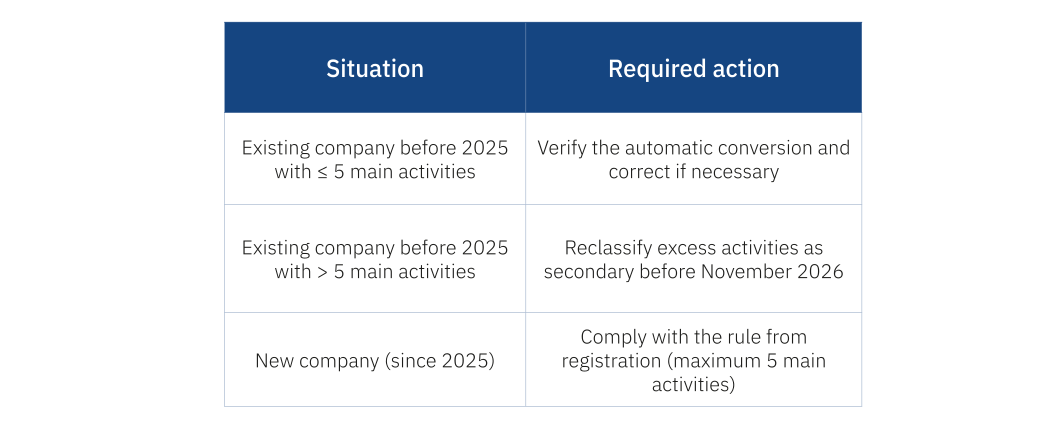
The reform applied immediately to new companies created from 28 March 2025 onwards: these can only register a maximum of five primary activities from the outset. For existing companies that already had more primary activities registered, a transitional period was granted. The deadline is set at November 2026: beyond that date, sanctions may apply.
B.F.S. can support you through this process. Do not hesitate to contact our teams for an audit of your company's situation, as well as to carry out this compliance assignment.